CGDGA#E Guitar Tuner
CGDGA#E | CGDGB♭E C9 - Guitar tuning, chords & scales
Verbal and Technical Analysis of the C9 Tuning
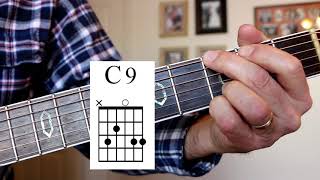
This unique Open C9 tuning, aptly named "C9" by its creator, offers a rich, full-bodied sound that's perfect for blues, jazz, and creative songwriting. As described by its designer, it's "an open C9 tuning that I thought would sound cool," and indeed it does. The open strings immediately establish a powerful C9 chord, providing a lush harmonic foundation for exploration.
Technically, the open strings are tuned to C2-G2-D3-G3-A#4-E4 (from low to high). This arrangement directly spells out a C9 chord (C-E-G-A#-D) across the instrument. The low C (C2) acts as the root, the G (G2 and G3) provides the perfect fifth, the E (E4) delivers the major third, A# (A#4, or Bb) supplies the flat seventh, and the D (D3) introduces the ninth. The D on the 4th string adds a distinct harmonic extension, creating a wonderfully resonant and complex open voicing. The overall feel is rich, dark, and highly resonant, capable of producing deep chordal voicings and melodic lines.
Open Chords and Reachable Shapes
The most obvious open chord is, of course, the C9 itself, which rings out beautifully without any fretting. This tuning is fantastic for creating expansive, ringing arpeggios over a C9 or C7 chord. Sliding this entire open shape up or down the neck will naturally yield other dominant 9th chords, offering immediate access to a wide harmonic palette (e.g., barring at the 2nd fret would give a D9). With minor adjustments, you can also easily derive C7 chords by muting or altering the 9th (D string), and Cmaj7 chords would require raising the A# to B on the 2nd string. The inherent intervallic relationships also make it conducive for crafting powerful power chords by barring the lower strings, and unique voicings by experimenting with finger placement around the established C9 framework, allowing for a dynamic playing experience in various keys.
How to Tune Your Guitar to C9
To achieve the C9 tuning from standard E-A-D-G-B-E, follow these specific string adjustments:
- 6th String (Low E): Tune down 4 semitones. The standard E2 string will become C2. Caution: Tuning down 4 semitones is a significant change. If you plan to use this tuning frequently, consider using a heavier gauge string for better tension and stability, as standard gauges may feel too loose or be more prone to breakage if tuned up this far (though this is a tune-down).
- 5th String (A): Tune down 2 semitones. The standard A2 string will become G2.
- 4th String (D): Keep as is; no change. The standard D3 string remains D3.
- 3rd String (G): Keep as is; no change. The standard G3 string remains G3.
- 2nd String (B): Tune down 1 semitone. The final note for this string is A#4.
- 1st String (High E): Keep as is; no change. The standard E4 string remains E4.
Always use a reliable tuner to ensure accuracy and prevent string breakage, especially when making significant pitch adjustments.
6th String (Low E): C2
5th String (A): G2
4th String (D): D3
3rd String (G): G3
2nd String (B): A#4
1st String (High E): E4
Loading an obscene
amount of Chords
Loading an obscene
amount of Scales
Loading Tuning Map
Loading Tuning Data
Comments - have your say on CGDGA#E
Capos for CGDGA#E
| Capo | Tuning | Name |
|---|---|---|
| 0 | CGDGA#E | C9 |
Please use the below form to submit a song for CGDGA#E that is not already on gtdb.org.
Videos for CGDGA#E on














Tuning Map
- Fret
- S6
- S5
- S4
- S3
- S2
- S1
- -13
- D#
- G#
- C#
- F#
- A#
- D#
- -12
- E
- A
- D
- G
- B
- E
- -11
- F
- A#
- D#
- G#
- C
- F
- -10
- F#
- B
- E
- A
- C#
- F#
- -9
- G
- C
- F
- A#
- D
- G
- -8
- G#
- C#
- F#
- B
- D#
- G#
- -7
- A
- D
- G
- C
- E
- A
- -6
- A#
- D#
- G#
- C#
- F
- A#
- -5
- B
- E
- A
- D
- F#
- B
- -4
- C
- F
- A#
- D#
- G
- C
- -3
- C#
- F#
- B
- E
- G#
- C#
- -2
- D
- G
- C
- F
- A
- D
- -1
- D#
- G#
- C#
- F#
- A#
- D#
- 0
- E
- A
- D
- G
- B
- E
- 1
- F
- A#
- D#
- G#
- C
- F
- 2
- F#
- B
- E
- A
- C#
- F#
- 3
- G
- C
- F
- A#
- D
- G
- 4
- G#
- C#
- F#
- B
- D#
- G#
- 5
- A
- D
- G
- C
- E
- A
- 6
- A#
- D#
- G#
- C#
- F
- A#
- 7
- B
- E
- A
- D
- F#
- B
- -4
- -2
- 0
- 0
- -1
- 0
 © 2026 GTDB