CGEGBE Guitar Tuner
CGEGBE Open Cmaj7 Tuning (CGEGBE) - Guitar tuning, chords & scales
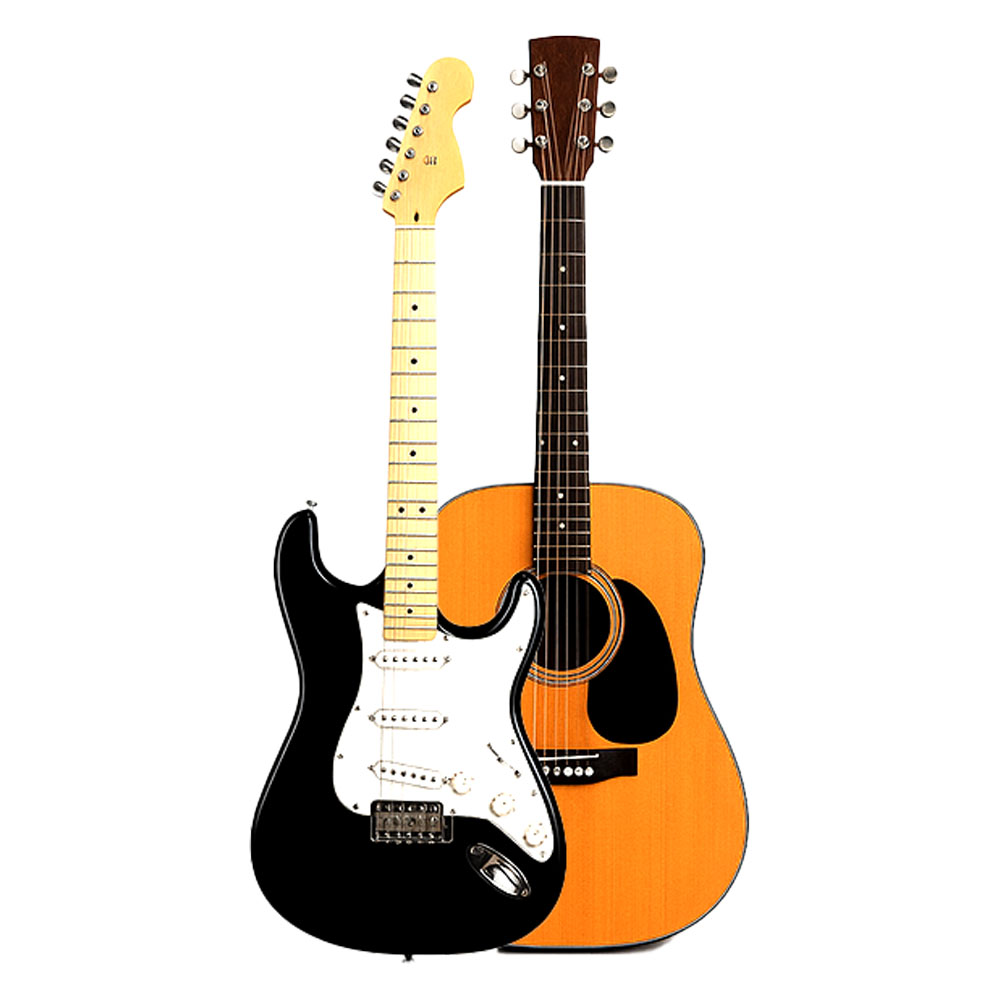
The tuning, originally named "Open Cmaj7 Tuning (CGEGBE)", transforms your guitar into a resonant soundscape, perfect for creating rich, ethereal harmonies. As described, it is indeed "EXTREMELY beautiful" and "great for new chords," offering a unique sonic palette for both fingerstyle players and those exploring new chord voicings and textures.
Verbal Analysis
This is a truly inspiring open tuning that immediately presents a full C Major 7 chord when strummed open. The wide range of notes, from the deep C2 on the lowest string to the bright E4 on the highest, creates a lush, ringing quality. It encourages a more melodic and less traditionally structured approach to playing, inviting players to discover intricate arpeggios, expressive slides, and innovative chord shapes that would be challenging or impossible in standard tuning. The arrangement of notes lends itself beautifully to ambient music, folk, and any genre seeking a harmonically rich and open sound.
Technical Analysis
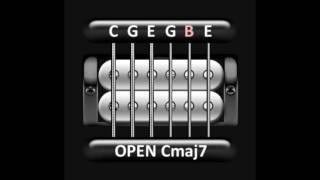
This tuning is configured for a standard Guitar. The open string notes are C2-G2-E3-G3-B3-E4 (from low E to high E string). Analytically, these notes form a C Major 7 chord:
- C (Root): Provided by the 6th string (C2).
- E (Major Third): Provided by the 4th string (E3) and 1st string (E4).
- G (Perfect Fifth): Provided by the 5th string (G2) and 3rd string (G3).
- B (Major Seventh): Provided by the 2nd string (B3).
The duplication of the E and G notes across different octaves and strings adds significant depth and resonance, creating a full and vibrant Cmaj7 voicing without any fretting. This open chord structure provides immediate harmonic richness.
Chordal Opportunities and Reach
The Open Cmaj7 tuning dramatically simplifies the creation of specific chords and opens doors to new voicings:
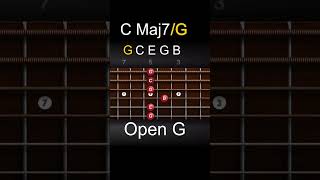
- Open Cmaj7 Chord: As its name suggests, simply strumming all open strings yields a powerful and beautiful Cmaj7 chord, perfect for sustained drones or introspective passages.
- Barre Chords Simplified: By barring all strings at any fret, you instantly create another Major 7 chord. For example, barring at the 5th fret produces an Fmaj7 chord, and at the 7th fret, a Gmaj7 chord. This makes modulations across major 7th chords incredibly intuitive and smooth.
- C Major Triad: Easily achieved by muting or avoiding the 2nd (B) string, or fretting it to a C (1st fret). The open C-G-E-G-E combination already provides a full C major sound.
- G Major / G7 Chords: With Gs on the 5th and 3rd strings, and E on the 4th and 1st strings, G major and G7 shapes become readily accessible with minimal fretting adjustments, often involving the 6th string (C) to act as a drone or a lower fifth.
- E Minor / E7 Chords: The open E strings (4th and 1st) and G strings (5th and 3rd) facilitate easy voicings of E minor or E7, making for interesting diatonic harmonies within the key of C.
- Droning and Embellishment: The low C and G notes provide a stable harmonic foundation, excellent for creating sustained drones while melodies or arpeggios are played on the higher strings. This is particularly effective for slide guitar or fingerstyle arrangements.
Overall, this tuning encourages exploration and offers a refreshing departure from standard tuning, making complex harmonies feel effortlessly accessible.
Tuning Notes
- 6th String (Low E): Tuned to C2
- 5th String (A): Tuned to G2
- 4th String (D): Tuned to E3
- 3rd String (G): Tuned to G3
- 2nd String (B): Tuned to B3
- 1st String (High E): Tuned to E4
How to Tune (from Standard EADGBe)
Important Considerations: When making significant changes to string tension, especially tuning up or down by 4 or more semitones, it is crucial to proceed with caution. For sustained use with such changes, considering a different string gauge may improve playability, tone, and prevent string breakage.
- 6th String (Low E to C2): Tune down 4 semitones. This is a significant drop from E2 to C2. While manageable, a heavier gauge string for the 6th string could offer better tension and tone stability in this lower register.
- 5th String (A to G2): Tune down 2 semitones. This is a moderate adjustment from A2 to G2 and generally safe for standard string gauges.
- 4th String (D to E3): Tune up 2 semitones. This is a moderate increase in tension from D3 to E3. Always tune slowly and carefully to avoid unnecessary stress on the string.
- 3rd String (G to G3): Keep as is; no change (0 semitones). The G3 note remains unchanged.
- 2nd String (B to B3): Keep as is; no change (0 semitones). The B3 note remains unchanged.
- 1st String (High E to E4): Keep as is; no change (0 semitones). The E4 note remains unchanged.
Loading an obscene
amount of Chords
Loading an obscene
amount of Scales
Loading Tuning Map
Loading Tuning Data
Comments - have your say on CGEGBE
Expand
Please use the below form to submit a song for CGEGBE that is not already on gtdb.org.
Videos for CGEGBE on














Tuning Map
- Fret
- S6
- S5
- S4
- S3
- S2
- S1
- -13
- D#
- G#
- C#
- F#
- A#
- D#
- -12
- E
- A
- D
- G
- B
- E
- -11
- F
- A#
- D#
- G#
- C
- F
- -10
- F#
- B
- E
- A
- C#
- F#
- -9
- G
- C
- F
- A#
- D
- G
- -8
- G#
- C#
- F#
- B
- D#
- G#
- -7
- A
- D
- G
- C
- E
- A
- -6
- A#
- D#
- G#
- C#
- F
- A#
- -5
- B
- E
- A
- D
- F#
- B
- -4
- C
- F
- A#
- D#
- G
- C
- -3
- C#
- F#
- B
- E
- G#
- C#
- -2
- D
- G
- C
- F
- A
- D
- -1
- D#
- G#
- C#
- F#
- A#
- D#
- 0
- E
- A
- D
- G
- B
- E
- 1
- F
- A#
- D#
- G#
- C
- F
- 2
- F#
- B
- E
- A
- C#
- F#
- 3
- G
- C
- F
- A#
- D
- G
- 4
- G#
- C#
- F#
- B
- D#
- G#
- 5
- A
- D
- G
- C
- E
- A
- 6
- A#
- D#
- G#
- C#
- F
- A#
- 7
- B
- E
- A
- D
- F#
- B
- -4
- -2
- 2
- 0
- 0
- 0
 © 2026 GTDB