DACF#AE Guitar Tuner
DACF#AE | DACG♭AE D9 - Guitar tuning, chords & scales
D9 Guitar Tuning Analysis
The D9 tuning for Guitar is a unique and expressive modification of standard tuning, aiming to open up new harmonic possibilities. As described, it's a sophisticated tuning designed to emulate an Am6 sound, offering rich voicings and unusual chord formations directly from open strings or with minimal fretwork.
Verbal Analysis
This tuning (D2 A2 C3 F#4 A3 E4) immediately presents a lush, somewhat melancholic, yet versatile soundscape. The tuning description highlights its ability to unlock "13ths, suspended 13ths, 6/9s, suspended 6/9s, major sus4, m6s" with relative ease. This suggests a tuning ripe for jazz, fusion, or experimental music where complex harmonies are desired without requiring extensive finger stretches. The wide interval between the 4th (C3) and 3rd (F#4) strings (an augmented fourth plus an octave) creates a striking, open dissonance that defines much of its character, while the repeated A notes (A2 and A3) and the D (D2) and E (E4) provide a strong root and fifth feel, underpinning an open minor tonality. The F#4 on the third string, especially relative to the A notes, clearly points towards the described Am6 possibilities, providing the major sixth in an A minor context.
Technical Analysis
The open strings are tuned to D2 A2 C3 F#4 A3 E4, from the lowest (6th) to the highest (1st) string. Let's examine the intervals between adjacent strings:
- String 6 to 5 (D2 to A2): Perfect Fifth (P5)
- String 5 to 4 (A2 to C3): Minor Third (m3)
- String 4 to 3 (C3 to F#4): Augmented Fourth / Tritone plus an Octave (A4 + Octave). This is a very wide and striking interval that will significantly influence the tuning's character.
- String 3 to 2 (F#4 to A3): Descending Minor Third (m3). Note the substantial drop in octave.
- String 2 to 1 (A3 to E4): Perfect Fifth (P5)
The open strings themselves do not form a single common chord, but the tuning's description as an "Am6 tuning" is highly relevant. If we consider A as the root, the notes present across the open strings are A (strings 5 & 2), C (string 4), E (string 1), F# (string 3, a major sixth above A), and D (string 6, a perfect fourth). An Am6 chord typically consists of A-C-E-F#. All these notes are present, with the D and additional A and E providing further extensions or bass notes. This setup provides excellent access to Am6 voicings, and with the D providing a strong fourth, sus4 chords are readily available. The significant drop from F#4 to A3 on consecutive strings also creates interesting melodic possibilities and unique fingerings, though it might require some adaptation for players accustomed to more gradual interval changes.
How to Tune
To achieve the D9 tuning from standard EADGBe, follow these string adjustments:
- String 6 (Low E String): Tune down 2 semitones from E2 to D2.
- String 5 (A String): Keep as is; no change (0 semitones) to A2.
- String 4 (D String): Tune down 2 semitones from D3 to C3.
- String 3 (G String): Tune down 1 semitone from G3 to F#3. (Note: While the provided target note for this string is F#4, the 'string_movements' instruction specifies tuning down 1 semitone from standard G3, which results in F#3. Achieving F#4 from G3 would be a significant upward adjustment (+11 semitones) and would definitely require a much lighter gauge string or an alternate setup.)
- String 2 (B String): Tune down 2 semitones from B3 to A3.
- String 1 (High E String): Keep as is; no change (0 semitones) to E4.
Important Note on String Gauge: Generally, string movements exceeding 4 semitones (either up or down) advise the use of a different gauge string to maintain optimal tension and prevent string breakage or excessive floppiness. In this tuning, most movements are within a reasonable range from standard EADGBe. However, the stated target of F#4 for the 3rd string, if attempted from a standard G3, would involve tuning up 11 semitones, which is well beyond the recommended range and would necessitate a lighter gauge string or alternative tuning approach for that specific string.
Below are the target notes for each string in the D9 tuning, from the lowest (6th) to the highest (1st):
- String 6 (Low E string position): D2
- String 5 (A string position): A2
- String 4 (D string position): C3
- String 3 (G string position): F#4
- String 2 (B string position): A3
- String 1 (High E string position): E4
Loading an obscene
amount of Chords
Loading an obscene
amount of Scales
Loading Tuning Map
Loading Tuning Data
Comments - have your say on DACF#AE
Capos for DACF#AE
| Capo | Tuning | Name |
|---|---|---|
| 0 | DACF#AE | D9 |
Please use the below form to submit a song for DACF#AE that is not already on gtdb.org.
Videos for DACF#AE on


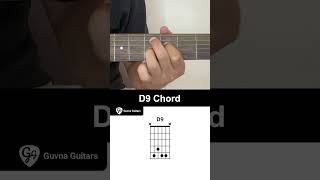
![Awesome Sounding Guitar Chord: D9 [X 5 4 5 5 5]](https://i.ytimg.com/vi/emJ59SDaZys/mqdefault.jpg)














Tuning Map
- Fret
- S6
- S5
- S4
- S3
- S2
- S1
- -13
- D#
- G#
- C#
- F#
- A#
- D#
- -12
- E
- A
- D
- G
- B
- E
- -11
- F
- A#
- D#
- G#
- C
- F
- -10
- F#
- B
- E
- A
- C#
- F#
- -9
- G
- C
- F
- A#
- D
- G
- -8
- G#
- C#
- F#
- B
- D#
- G#
- -7
- A
- D
- G
- C
- E
- A
- -6
- A#
- D#
- G#
- C#
- F
- A#
- -5
- B
- E
- A
- D
- F#
- B
- -4
- C
- F
- A#
- D#
- G
- C
- -3
- C#
- F#
- B
- E
- G#
- C#
- -2
- D
- G
- C
- F
- A
- D
- -1
- D#
- G#
- C#
- F#
- A#
- D#
- 0
- E
- A
- D
- G
- B
- E
- 1
- F
- A#
- D#
- G#
- C
- F
- 2
- F#
- B
- E
- A
- C#
- F#
- 3
- G
- C
- F
- A#
- D
- G
- 4
- G#
- C#
- F#
- B
- D#
- G#
- 5
- A
- D
- G
- C
- E
- A
- 6
- A#
- D#
- G#
- C#
- F
- A#
- 7
- B
- E
- A
- D
- F#
- B
- -2
- 0
- -2
- -1
- -2
- 0
 © 2026 GTDB