DADDGA# Guitar Tuner
DADDGA# | DADDGB♭ Celtic Tuning Variation - Guitar tuning, chords & scales
Tuning Overview: Celtic Tuning Variation
This intriguing tuning, known as the "Celtic tuning variation," draws its inspiration from the Irish rock band Dea Matrona, who utilized it in the acoustic version of their song "Stuck on You." It's an excellent example of how altering standard guitar tuning can unlock entirely new harmonic possibilities and a distinct sonic landscape, often characterized by open, ringing tones and modal flavors typical of Celtic-influenced music.
Technical Analysis
The open strings for this tuning are D2 A2 D3 D3 G3 A#4 (which is enharmonically Bb4). Let's break down the intervals and potential harmonies:
- Lowest Strings (D2-A2-D3): The lowest three strings form a powerful D5 power chord (Root-Fifth-Octave). This provides a strong, resonant bass foundation.
- Overall Open Chord: When all open strings are strummed, the tuning presents a rich, complex harmony consisting of D, A, G, and A# (Bb). Interpreted from the root D, this includes the Root (D), Perfect 5th (A), Perfect 4th (G), and a Minor 6th (A# or Bb). This combination often points towards a Dorian or Phrygian mode influence, or can be seen as a G minor chord (G-Bb-D) voiced over a D root (Gm/D) with an added A (the 5th of D), creating a lush, somewhat melancholic, and definitely open-sounding chord.
- Doubled D: The 4th and 3rd strings are both tuned to D3, adding significant resonance and sustain to the D note, reinforcing the tonic.
- Unique Intervals: The juxtaposition of the G (4th) and A# (minor 6th/b6) against the D root creates interesting dissonances and suspensions, making this tuning particularly expressive for arpeggios and melodic lines.
Chords and Playability
This tuning inherently facilitates certain chord voicings and melodic approaches:
- Open & Drone Chords: The D5 on the lower strings, combined with the D-G-A# (Bb) on the higher strings, makes for a very resonant open sound. Drone notes are easily achievable, creating a full and sustained backdrop for melodies.
- Fingering Advantages: Chords based around D minor, G minor, or suspended chords might become significantly easier to finger due to the altered intervals. The doubled D notes can also simplify certain chord shapes.
- Modal Exploration: The specific blend of notes encourages exploration of modal scales and melodies, especially those with a minor or suspended quality. The high A# (Bb) adds a distinctive flavor that distinguishes it from more common open tunings.
- Challenges: Common major and minor chords from standard tuning will require completely new fingerings and may not translate directly. Players will need to adapt their chord vocabulary to this unique layout.
How to Tune Your Guitar
To achieve the "Celtic Tuning Variation" from standard E Standard tuning (E-A-D-G-B-E), follow these precise adjustments:
- 6th String (Low E): Tune down 2 semitones from E2 to D2.
- 5th String (A): Keep as is; no change (0 semitones). It remains at A2.
- 4th String (D): Keep as is; no change (0 semitones). It remains at D3.
- 3rd String (G): Tune down 5 semitones from G3 to D3. Caution: Tuning down 5 semitones is a substantial drop in pitch. For optimal tension and playability, it is strongly advised to consider using a heavier gauge string for this position.
- 2nd String (B): Tune down 4 semitones from B3 to G3. Caution: Tuning down 4 semitones is a significant drop. Consider a heavier gauge string for this string to maintain better tension and intonation.
- 1st String (High E): Tune down 6 semitones from E4 to A#4. Extreme Caution: Tuning down 6 semitones is a very substantial change. It is strongly advised to use a significantly heavier gauge string for this string to maintain playability, avoid excessive looseness, and ensure proper intonation.
General Note on String Gauges: For any string movement exceeding 4 semitones (either up or down), a different gauge string is typically recommended to maintain optimal string tension, intonation, and to prevent potential damage or excessive slackness.
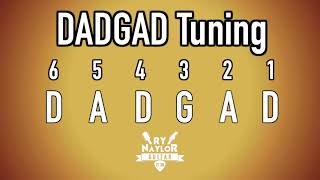
6th String: D2
5th String: A2
4th String: D3
3rd String: D3
2nd String: G3
1st String: A#4
Loading an obscene
amount of Chords
Loading an obscene
amount of Scales
Loading Tuning Map
Loading Tuning Data
Comments - have your say on DADDGA#
Capos for DADDGA#
| Capo | Tuning | Name |
|---|---|---|
| 0 | DADDGA# | Celtic Tuning Variation |
Please use the below form to submit a song for DADDGA# that is not already on gtdb.org.
Videos for DADDGA# on











Tuning Map
- Fret
- S6
- S5
- S4
- S3
- S2
- S1
- -13
- D#
- G#
- C#
- F#
- A#
- D#
- -12
- E
- A
- D
- G
- B
- E
- -11
- F
- A#
- D#
- G#
- C
- F
- -10
- F#
- B
- E
- A
- C#
- F#
- -9
- G
- C
- F
- A#
- D
- G
- -8
- G#
- C#
- F#
- B
- D#
- G#
- -7
- A
- D
- G
- C
- E
- A
- -6
- A#
- D#
- G#
- C#
- F
- A#
- -5
- B
- E
- A
- D
- F#
- B
- -4
- C
- F
- A#
- D#
- G
- C
- -3
- C#
- F#
- B
- E
- G#
- C#
- -2
- D
- G
- C
- F
- A
- D
- -1
- D#
- G#
- C#
- F#
- A#
- D#
- 0
- E
- A
- D
- G
- B
- E
- 1
- F
- A#
- D#
- G#
- C
- F
- 2
- F#
- B
- E
- A
- C#
- F#
- 3
- G
- C
- F
- A#
- D
- G
- 4
- G#
- C#
- F#
- B
- D#
- G#
- 5
- A
- D
- G
- C
- E
- A
- 6
- A#
- D#
- G#
- C#
- F
- A#
- 7
- B
- E
- A
- D
- F#
- B
- -2
- 0
- 0
- -5
- -4
- -6
 © 2026 GTDB