EBE Phin Tuner
EBE Roman Anton KingPhin - Phin tuning, chords & scales
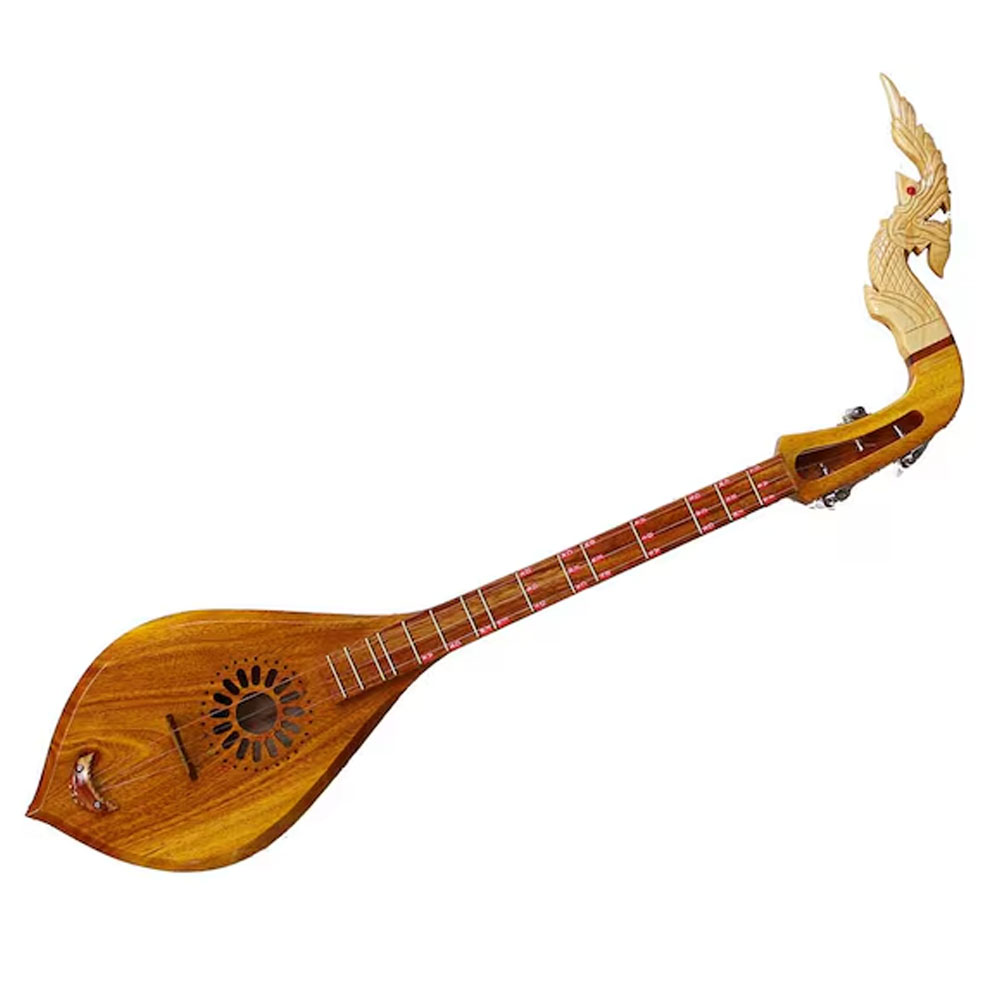
Tuning Analysis: Roman Anton KingPhin (3-String Lute)
The Roman Anton KingPhin is a distinctive and culturally significant tuning, specified for a 3-string Lute. This tuning is explicitly described as a Thai Phin tuning as utilized by Roman Anton, emphasizing its roots in traditional Southeast Asian music.
Verbal Analysis
This tuning immediately presents a bright, open, and resonant character. The arrangement of notes, particularly the repeated E at different octaves, creates a strong harmonic foundation that lends itself beautifully to drone-based playing and intricate melodic lines. It evokes a sense of spaciousness and clarity, characteristic of many traditional folk instruments. The tuning's simplicity (E-B-E) allows for expressive playing where the player can imply various harmonic colors through melodic embellishments rather than relying solely on complex chord voicings. It is well-suited for both rhythmic patterns and soulful, sustained melodies.
Technical Analysis
The open strings for the 3-string Lute in this tuning are:
- String 3 (Lowest): E3
- String 2 (Middle): B3
- String 1 (Highest): E4
When all three open strings are strummed, they form an E5 (Power Chord). Let's look at the intervals between the strings:
- Between String 3 (E3) and String 2 (B3): A Perfect Fifth (7 semitones).
- Between String 2 (B3) and String 1 (E4): A Perfect Fourth (5 semitones).
The perfect fifth between the lower two strings provides a robust, harmonically stable foundation, while the perfect fourth to the highest string completes the octave, creating a very balanced and ringing open chord.
Accessible Chords and Voicings
- Open E5: The most immediate and strong voicing is the open E power chord (E-B-E), which is powerful and resonant.
- Implied E Major/Minor: By fretting String 2 at the 3rd fret (G) or 4th fret (G#), you can easily create E minor (E-B-G-E) or E major (E-B-G#-E) chord voicings, often with the highest E (String 1) sustaining as a drone.
- Movable Power Chords: The perfect fifth interval between String 3 and String 2 makes it incredibly easy to form movable two-string power chords by barring or fretting these two strings at any fret. For example, moving up to the 5th fret on String 3 (A) and 7th fret on String 2 (E) yields an A5 power chord, with the open String 1 (E4) reinforcing the fifth.
- Drone and Melodic Flexibility: This tuning is ideal for playing melodies over sustained open E notes, or using the open strings as a constant drone while fretting melodic passages on one or two strings.
How to Tune
To achieve the Roman Anton KingPhin tuning for your 3-string Lute, follow these precise string adjustments:
- String 3 (Lowest, Target E3): Tune down 3 semitones.
- String 2 (Middle, Target B3): Keep as is; no change (0 semitones).
- String 1 (Highest, Target E4): Keep as is; no change (0 semitones).
Important Note on String Gauge: When tuning a string down by more than 4 semitones, or up by 4 semitones or more, it is generally recommended to consider using a different gauge string. This helps maintain appropriate string tension, optimize tone, and prevent potential damage to the instrument or the string itself. For this tuning, String 3 requires a moderate adjustment of tuning down 3 semitones, which should typically be well within the safe and effective range for standard string gauges. Always proceed with caution when making any significant tuning adjustments.
Here are the specific open notes for each string in the Roman Anton KingPhin tuning:
- String 3 (Lowest): E3
- String 2 (Middle): B3
- String 1 (Highest): E4
Loading an obscene
amount of Chords
Loading an obscene
amount of Scales
Loading Tuning Map
Loading Tuning Data
Comments - have your say on EBE
Capos for EBE
| Capo | Tuning | Name |
|---|---|---|
| 0 | EBE | Roman Anton KingPhin |
Please use the below form to submit a song for EBE that is not already on gtdb.org.
Videos for EBE on
















 © 2026 GTDB