FFA#D#GA# Guitar Tuner
FFA#D#GA# | FFB♭E♭GB♭ F F A# D# G A# - Guitar tuning, chords & scales
Verbal Analysis
The "F Deep Altered Drop" tuning plunges your guitar into an exceptionally low and resonant soundscape. With the lowest two strings tuned to F1 and F2 respectively, this tuning provides an incredibly deep, almost guttural foundation that will rumble through any mix. The description "Double Drop A# but the low A# is tuned to F1" truly highlights its departure from conventional tunings. It's built for extreme weight, offering a sonic texture that is both massive and somewhat unsettling.
This tuning is ideal for genres that demand immense low-end power and unconventional harmonies, such as ultra-heavy metal, djent, experimental, or ambient sound design. It discourages typical open chord shapes and instead encourages droning, single-note riffs, and intricate arpeggios that can exploit its unique intervallic relationships. The overall feel is dark, aggressive, and highly textural, pushing the boundaries of what a standard guitar can achieve.
Technical Analysis
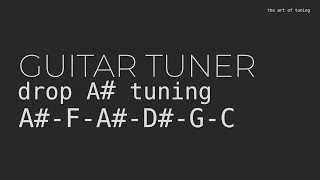
This is a six-string tuning set to: F1, F2, A3#, D4#, G3, A4#.
- The most striking feature is the unison F on the 6th (F1) and 5th (F2) strings, an entire octave apart. This creates an incredibly thick and resonant power chord foundation, making palm-muted riffs exceptionally heavy.
- Moving up, the 4th string is A#3, forming a Major 10th (compound Major 3rd) above the 5th string's F2. This F-A# interval (F to A# is a Major 3rd or an Augmented 2nd, depending on interpretation, but more commonly a Major 3rd) adds a bluesy or Lydian flavor, but in such a low register, it primarily serves to thicken chords.
- The 3rd string is D4#, creating an augmented 5th (G3 to D#4) or a tritone from the 4th string (A#3 to D#4 is a Perfect 4th). This interval (P4) between the 4th and 3rd strings is a common feature in drop tunings, facilitating easy power chords on those strings.
- The 2nd string is G3, which is actually lower than the 3rd string (D4#). This is a very unusual drop for the 2nd string, creating a significant descending interval (D#4 to G3 is a descending augmented 5th). This non-linear string progression makes traditional scale shapes challenging and invites exploration of new fretboard patterns.
- Finally, the 1st string is A4#, completing a compound minor 3rd (G3 to A#4) from the 2nd string.
Open strings (F1, F2, A#3, D4#, G3, A4#) do not form a conventional triad. However, the presence of F, F, A# suggests an Fsus4 harmony if we consider C to be implied. The full set of notes is highly dissonant in isolation, pointing towards a use case that prioritizes texture and heavy riffing over traditional melodic harmony.
Chords and Shapes
Traditional open chords are largely absent in this tuning due to its extreme nature. However, certain shapes become very accessible:
- Massive Power Chords: The unison F (F1, F2) on the lowest two strings allows for incredibly thick, droning power chords simply by barring across these strings at any fret. For instance, an open 'chord' on strings 6 and 5 (F1, F2) is a rich, full F power dyad.
- Easy Drop-Tuned Chords: The Perfect 4th interval between the 4th (A#3) and 3rd (D4#) strings means that two-finger power chords (e.g., finger on 4th string, same fret; finger on 3rd string, two frets higher) are readily available.
- Droning Open Harmonies: The F1, F2, A#3 (6th, 5th, 4th strings) can be played open to create a deep, Fsus4-like drone.
- Minor Third Shapes: The minor 3rd interval between G3 (2nd string) and A#4 (1st string) can be exploited for bluesy or heavy minor harmony on the higher strings.
This tuning encourages exploring new melodic and harmonic possibilities, favoring a percussive, low-frequency attack and intricate single-note lines over standard chord voicings.
Open String Notes
- 6th String (Low E): F1 - The lowest string, tuned to F in the first octave, providing an incredibly deep, resonant foundation.
- 5th String (A): F2 - Tuned to F in the second octave, a perfect octave above the 6th string, creating a thick unison sound.
- 4th String (D): A3# - Tuned to A sharp (or B flat) in the third octave.
- 3rd String (G): D4# - Tuned to D sharp (or E flat) in the fourth octave.
- 2nd String (B): G3 - Tuned to G in the third octave, notably lower than the 3rd string.
- 1st String (High E): A4# - The highest string, tuned to A sharp (or B flat) in the fourth octave.
How to Tune Your Guitar
This tuning involves significant drops for almost all strings. For movements exceeding 4 semitones (either up or down), a different gauge string is strongly advised to maintain proper tension, intonation, and to prevent potential damage to your instrument or strings.
- 6th String (Low E): Tune down 11 semitones to F1. This is a very significant drop, approaching an entire octave. A heavier gauge string designed for ultra-low tunings is strongly recommended to maintain tension and tone.
- 5th String (A): Tune down 4 semitones to F2. This is at the upper limit for standard gauge strings. Consider a slightly heavier gauge for optimal performance and string longevity.
- 4th String (D): Tune down 4 semitones to A3#. This is at the upper limit for standard gauge strings. Consider a slightly heavier gauge for optimal performance and string longevity.
- 3rd String (G): Tune down 4 semitones to D4#. This is at the upper limit for standard gauge strings. Consider a slightly heavier gauge for optimal performance and string longevity.
- 2nd String (B): Tune down 4 semitones to G3. This is at the upper limit for standard gauge strings. Consider a slightly heavier gauge for optimal performance and string longevity.
- 1st String (High E): Tune down 6 semitones to A4#. This is a substantial drop. A heavier gauge string is recommended for optimal tension and tone, as well as improved playability.
Given the extensive tuning down, particularly on the 6th and 1st strings, regular checks on neck relief and intonation are highly recommended after switching to this tuning.
Loading an obscene
amount of Chords
Loading an obscene
amount of Scales
Loading Tuning Map
Loading Tuning Data
Comments - have your say on FFA#D#GA#
Please use the below form to submit a song for FFA#D#GA# that is not already on gtdb.org.
Videos for FFA#D#GA# on















Tuning Map
- Fret
- S6
- S5
- S4
- S3
- S2
- S1
- -13
- D#
- G#
- C#
- F#
- A#
- D#
- -12
- E
- A
- D
- G
- B
- E
- -11
- F
- A#
- D#
- G#
- C
- F
- -10
- F#
- B
- E
- A
- C#
- F#
- -9
- G
- C
- F
- A#
- D
- G
- -8
- G#
- C#
- F#
- B
- D#
- G#
- -7
- A
- D
- G
- C
- E
- A
- -6
- A#
- D#
- G#
- C#
- F
- A#
- -5
- B
- E
- A
- D
- F#
- B
- -4
- C
- F
- A#
- D#
- G
- C
- -3
- C#
- F#
- B
- E
- G#
- C#
- -2
- D
- G
- C
- F
- A
- D
- -1
- D#
- G#
- C#
- F#
- A#
- D#
- 0
- E
- A
- D
- G
- B
- E
- 1
- F
- A#
- D#
- G#
- C
- F
- 2
- F#
- B
- E
- A
- C#
- F#
- 3
- G
- C
- F
- A#
- D
- G
- 4
- G#
- C#
- F#
- B
- D#
- G#
- 5
- A
- D
- G
- C
- E
- A
- 6
- A#
- D#
- G#
- C#
- F
- A#
- 7
- B
- E
- A
- D
- F#
- B
- -11
- -4
- -4
- -4
- -4
- -6
 © 2026 GTDB