ADADG Cittern Tuner
ADADG Open D - Cittern tuning, chords & scales
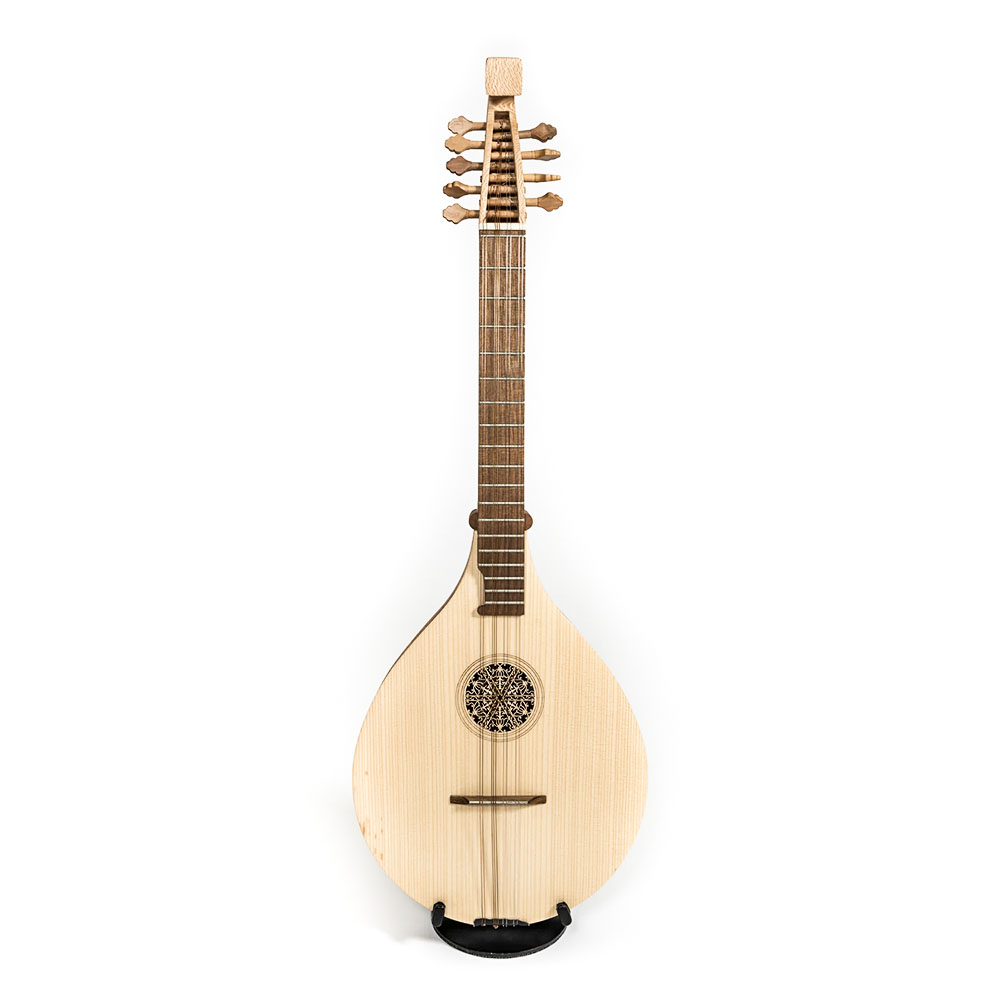
Welcome to the Open D Cittern Tuning, a resonant and versatile setup specifically designed for playing melody and accompaniment in Traditional Irish Music. This tuning imbues your cittern with a rich, drone-like quality, making it ideal for the expressive and often modal nature of Celtic tunes.
Technical Analysis
The Open D tuning for this 5-string cittern is configured as A2-D3-A3-D4-G4 (from lowest to highest string). This arrangement creates an open Dsus4 chord, meaning that when all strings are played open, they resonate a D chord with a suspended 4th (G note). This natural suspension adds a beautiful, airy quality that is highly characteristic of traditional folk music.
The intervals between the strings are strategically chosen for ease of playing and rich harmonic texture:
- 5th String (A2) to 4th String (D3): Perfect 4th
- 4th String (D3) to 3rd String (A3): Perfect 5th
- 3rd String (A3) to 2nd String (D4): Perfect 4th
- 2nd String (D4) to 1st String (G4): Perfect 4th
Chords and Playability
This tuning naturally provides a full Dsus4 chord (A-D-A-D-G) when played open. This makes it incredibly easy to start playing tunes in the key of D, focusing on melody while the open strings provide a sympathetic drone.
Due to the open intervals, many common chords become easily accessible with minimal fingering:
- D Major: While the open tuning is Dsus4, a full D Major triad (D-F#-A) can be easily formed. For instance, by using the open D and A strings and fretting a D string at the 4th fret to obtain F#, rich voicings of D major become readily available.
- G Major: A G Major chord can be achieved by barring across certain frets or using specific fingerings, leveraging the G4 on the highest string and D notes.
- A Major/Minor: The presence of two A notes (A2, A3) makes A-based chords particularly resonant. An A major or minor can be constructed around these natural open strings.
- Modal Playing: The open intervals are perfectly suited for modal melodies and harmonies, especially in D Dorian or Mixolydian, which are prevalent in Irish traditional music.
This tuning simplifies many chord shapes, allowing players to focus more on intricate melodic lines and ornamentation, which are hallmarks of the style. The deep resonance provided by the open strings acts as a constant harmonic foundation.
The Open D tuning for your Cittern consists of the following notes:
- 5th String: A2 (Lowest String)
- 4th String: D3
- 3rd String: A3
- 2nd String: D4
- 1st String: G4 (Highest String)
How to Tune
To achieve the Open D Cittern tuning, please adjust your strings as follows. These movements are based on your current setup to reach the specified notes.
- 5th String (Lowest): Tune up 5 semitones to reach A2.
- 4th String: Tune up 5 semitones to reach D3.
- 3rd String: Tune up 7 semitones to reach A3.
- 2nd String: Tune up 7 semitones to reach D4.
- 1st String (Highest): Tune up 3 semitones to reach G4.
Important Note on String Gauge: When tuning a string up by more than 4 semitones, or down by more than 4 semitones, it is generally advised to consider using a different gauge string. This helps maintain proper string tension, protects your instrument from undue stress, and ensures optimal playability and tone. For this tuning, the 5th, 4th, 3rd, and 2nd strings all require tuning up by 5 semitones or more. Please exercise caution and assess if a change in string gauge might be beneficial for your instrument.
Loading an obscene
amount of Chords
Loading an obscene
amount of Scales
Loading Tuning Map
Loading Tuning Data
Comments - have your say on ADADG
Capos for ADADG
| Capo | Tuning | Name |
|---|---|---|
| 0 | ADADG | Open D |
Please use the below form to submit a song for ADADG that is not already on gtdb.org.
Videos for ADADG on







Tuning Map
- Fret
- S6
- S5
- S4
- S3
- S1
- -13
- D#
- G#
- C#
- F#
- D#
- -12
- E
- A
- D
- G
- E
- -11
- F
- A#
- D#
- G#
- F
- -10
- F#
- B
- E
- A
- F#
- -9
- G
- C
- F
- A#
- G
- -8
- G#
- C#
- F#
- B
- G#
- -7
- A
- D
- G
- C
- A
- -6
- A#
- D#
- G#
- C#
- A#
- -5
- B
- E
- A
- D
- B
- -4
- C
- F
- A#
- D#
- C
- -3
- C#
- F#
- B
- E
- C#
- -2
- D
- G
- C
- F
- D
- -1
- D#
- G#
- C#
- F#
- D#
- 0
- E
- A
- D
- G
- E
- 1
- F
- A#
- D#
- G#
- F
- 2
- F#
- B
- E
- A
- F#
- 3
- G
- C
- F
- A#
- G
- 4
- G#
- C#
- F#
- B
- G#
- 5
- A
- D
- G
- C
- A
- 6
- A#
- D#
- G#
- C#
- A#
- 7
- B
- E
- A
- D
- B
- 5
- 5
- 7
- 7
- 3
 © 2026 GTDB