DACEAD Guitar Tuner
DACEAD DACEAD - Guitar tuning, chords & scales
Tuning Overview: DACEAD
The DACEAD tuning is a rich and resonant open tuning designed to offer a powerful "wall-of-sound" experience, particularly around D and A. It's an excellent choice for players looking for expansive voicings and accessible chord shapes.
Verbal Analysis
This tuning is incredibly versatile, emphasizing the root (D) and its perfect fifth (A) across the fretboard. The open strings immediately create a full, dominant sound, with the C and E notes adding rich harmonic color. It's described as providing easy access for 2nd/9th, 3rds, and 7ths, which is evident in the harmonic structure. The arrangement facilitates easy barre chords, allowing players to quickly transpose shapes up and down the neck while maintaining a full, ringing quality.
The design with open D and A strings forming a strong base, while C and E are available for melodic lines, makes it ideal for both rhythmic strumming and intricate lead work. Imagine a vast, open soundscape, perfect for creating atmospheric textures or driving rock anthems.
Technical Analysis
The open notes for DACEAD are:
- String 6: D2 (Root)
- String 5: A2 (Perfect 5th)
- String 4: C3 (Minor 7th)
- String 3: E3 (Major 9th / Major 2nd)
- String 2: A3 (Octave of Perfect 5th)
- String 1: D4 (Octave of Root)
When strummed open, this tuning produces a rich chord featuring the root (D), perfect fifth (A), minor seventh (C), and major ninth (E). While it includes the components of a D dominant 9th chord (D9), it technically omits the major third (F#), making it a D(no3rd)add9. This gives it a versatile, open sound that can lean towards dominant, suspended, or even minor contexts depending on how it's voiced with additional fretted notes. The repetition of D and A notes at different octaves provides a strong foundation and sustain.
Open & Accessible Chords
- Open Chord: The open strings form a rich D(no3rd)add9 chord voicing (D-A-C-E-A-D). This chord is ready to ring out immediately without any fretting.
- Barre Chords: The structure, with the repeated D and A notes, lends itself exceptionally well to movable barre chords. By barring all strings at a single fret, you can easily create movable voicings that leverage the root-fifth-minor seventh-ninth pattern. For example, barring at the 2nd fret yields an E(no3rd)add9 chord (E-B-D-F#-B-E), and barring at the 5th fret yields a G(no3rd)add9 chord (G-D-F-A-D-G). This makes chord progressions very fluid.
- Power Chords: The low D-A and high A-D pairings make it simple to form powerful 5th chords (power chords) by simply fretting the lower strings.
Tuning Details & How to Tune
Open String Notes:
- String 6 (Low E): D2
- String 5 (A): A2
- String 4 (D): C3
- String 3 (G): E3
- String 2 (B): A3
- String 1 (High E): D4
How to Tune (Starting from Standard EADGBe Tuning):
- String 6 (Low E to D2): Tune down 2 semitones from E to D. This is a moderate adjustment and should be safe for standard gauge strings.
- String 5 (A to A2): Keep as is; no change (0 semitones). This string remains at its standard pitch.
- String 4 (D to C3): Tune down 2 semitones from D to C. This is a moderate adjustment and should be safe for standard gauge strings.
- String 3 (G to E3): Tune down 3 semitones from G to E. This is a moderate adjustment and should be safe for standard gauge strings.
- String 2 (B to A3): Tune down 2 semitones from B to A. This is a moderate adjustment and should be safe for standard gauge strings.
- String 1 (High E to D4): Tune down 2 semitones from E to D. This is a moderate adjustment and should be safe for standard gauge strings.
Important Note on String Gauge: All string movements in this tuning are within a -3 semitone range. Generally, tuning up 3 or 4 semitones or down more than 4 semitones may require a different string gauge to maintain optimal tension and prevent string breakage or floppiness. For this DACEAD tuning, the adjustments are moderate, and your standard gauge strings should generally accommodate these changes safely. However, always proceed with care and listen to your guitar's response.
Loading an obscene
amount of Chords
Loading an obscene
amount of Scales
Loading Tuning Map
Loading Tuning Data
Comments - have your say on DACEAD
Please use the below form to submit a song for DACEAD that is not already on gtdb.org.
Videos for DACEAD on





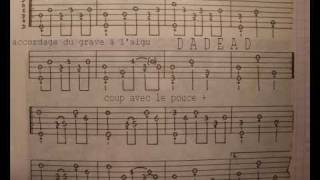


![[ギターチューニング/DADEAD] 音にあわせる→完了[アコギ]](https://i.ytimg.com/vi/tdtbn1pp84g/mqdefault.jpg)
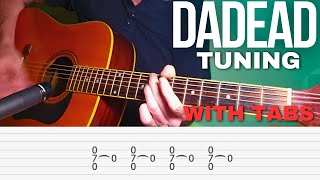





Tuning Map
- Fret
- S6
- S5
- S4
- S3
- S2
- S1
- -13
- D#
- G#
- C#
- F#
- A#
- D#
- -12
- E
- A
- D
- G
- B
- E
- -11
- F
- A#
- D#
- G#
- C
- F
- -10
- F#
- B
- E
- A
- C#
- F#
- -9
- G
- C
- F
- A#
- D
- G
- -8
- G#
- C#
- F#
- B
- D#
- G#
- -7
- A
- D
- G
- C
- E
- A
- -6
- A#
- D#
- G#
- C#
- F
- A#
- -5
- B
- E
- A
- D
- F#
- B
- -4
- C
- F
- A#
- D#
- G
- C
- -3
- C#
- F#
- B
- E
- G#
- C#
- -2
- D
- G
- C
- F
- A
- D
- -1
- D#
- G#
- C#
- F#
- A#
- D#
- 0
- E
- A
- D
- G
- B
- E
- 1
- F
- A#
- D#
- G#
- C
- F
- 2
- F#
- B
- E
- A
- C#
- F#
- 3
- G
- C
- F
- A#
- D
- G
- 4
- G#
- C#
- F#
- B
- D#
- G#
- 5
- A
- D
- G
- C
- E
- A
- 6
- A#
- D#
- G#
- C#
- F
- A#
- 7
- B
- E
- A
- D
- F#
- B
- -2
- 0
- -2
- -3
- -2
- -2
 © 2026 GTDB