D#A#FA#D#GC Guitar Tuner
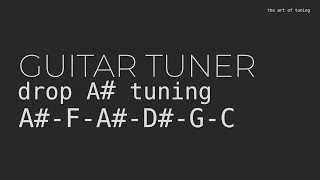
D#A#FA#D#GC | E♭B♭FB♭E♭GC Drop D#/A# - Guitar tuning, chords & scales
The Drop D#/A# tuning is a heavy and unconventional seven-string setup, notably used by bands like Gravemind on their album "Conduit." This tuning plunges the guitar into a profoundly low register, perfect for achieving crushing riffs and a dense, impactful sound often associated with modern metal subgenres such as djent, progressive metal, and deathcore.
Technically, this tuning presents a fascinating and unique arrangement of notes. The open strings are: D2#, A2#, F2, A3#, D4#, G3, C4. Let's break down the intervals and potential voicings:
- The two lowest strings (String 7: D2#, String 6: A2#) form a perfect fifth, creating a strong D# power chord (D#5) which is easily accessible for heavy riffing.
- Extending this, the lowest three strings (D2#, A2#, F2) beautifully spell out an open D# minor triad (D# - F - A#), providing a rich, dark harmonic foundation. This makes it incredibly easy to hit a D# minor chord with just the lowest three strings open.
- Moving up, the jump from String 5 (F2) to String 4 (A3#) is an octave and a perfect fourth (17 semitones), which is a significant leap in pitch.
- Perhaps the most distinctive and unconventional aspect is the relationship between String 3 (D4#) and String 2 (G3). G3 is actually tuned 9 semitones lower than D4# (a Major 6th down), creating an inverted interval. This inversion can lead to unique chord voicings and drone possibilities that are not typically found in standard tunings, challenging players to explore new harmonic landscapes.
- The highest two strings (String 2: G3, String 1: C4) form a perfect fourth, a common interval for upper-string chords.
Due to the dropped lowest strings and the open D# minor chord on strings 7-5, this tuning excels in creating very heavy, resonant open-string chugs and complex, dissonant textures when combined with the higher strings. The open D# minor triad provides a clear harmonic center, while the unique arrangement of the higher strings invites experimentation with wide intervals and unconventional arpeggios.
How to Tune to Drop D#/A#
To achieve the Drop D#/A# tuning, you will need to adjust each string as follows. Please take care when tuning, especially with significant pitch changes. For movements exceeding 4 semitones up or down, considering a different gauge string is advisable to maintain optimal tension and prevent string damage.
- String 7 (Lowest String): Tune this string down 8 semitones to a D#2. (Note: Tuning down 8 semitones is a significant change; a heavier gauge string is recommended for proper tension.)
- String 6: Tune this string down 6 semitones to an A#2. (Note: Tuning down 6 semitones is a significant change; a heavier gauge string is recommended for proper tension.)
- String 5: Tune this string down 4 semitones to an F2. (Note: Tuning down 4 semitones is at the limit for standard gauges; a heavier string might be beneficial.)
- String 4: Tune this string down 4 semitones to an A#3. (Note: Tuning down 4 semitones is at the limit for standard gauges; a heavier string might be beneficial.)
- String 3: Tune this string down 4 semitones to a D#4. (Note: Tuning down 4 semitones is at the limit for standard gauges; a heavier string might be beneficial.)
- String 2: Tune this string down 4 semitones to a G3. (Note: Tuning down 4 semitones is at the limit for standard gauges; a heavier string might be beneficial.)
- String 1 (Highest String): Tune this string down 4 semitones to a C4. (Note: Tuning down 4 semitones is at the limit for standard gauges; a heavier string might be beneficial.)
Here are the notes for each string in this tuning, from the lowest (typically string 7 for a 7-string guitar) to the highest (string 1):
- String 7: D2#
- String 6: A2#
- String 5: F2
- String 4: A3#
- String 3: D4#
- String 2: G3
- String 1: C4
Loading an obscene
amount of Chords
Loading an obscene
amount of Scales
Loading Tuning Map
Loading Tuning Data
Comments - have your say on D#A#FA#D#GC
Capos for D#A#FA#D#GC
| Capo | Tuning | Name |
|---|---|---|
| -1 | DAEADF#B | Drop A/D |
| 0 | D#A#FA#D#GC | Drop D#/A# |
| 1 | EBF#BEG#C# | EBF#BEG#C# |
| 2 | FCGCFAD | DROP F/C |
| 3 | F#C#G#C#F#A#D# | Hybrid Drop C# / Drop F# |
| 4 | GDADGBE | Double Drop G |
Please use the below form to submit a song for D#A#FA#D#GC that is not already on gtdb.org.
Videos for D#A#FA#D#GC on










![TUNNING DROP C# [ C# G# C# F# A# D# ]](https://i.ytimg.com/vi/5Inrp6VRD2I/mqdefault.jpg)




Tuning Map
- Fret
- S7
- S6
- S5
- S4
- S3
- S2
- S1
- -13
- A#
- D#
- G#
- C#
- F#
- A#
- D#
- -12
- B
- E
- A
- D
- G
- B
- E
- -11
- C
- F
- A#
- D#
- G#
- C
- F
- -10
- C#
- F#
- B
- E
- A
- C#
- F#
- -9
- D
- G
- C
- F
- A#
- D
- G
- -8
- D#
- G#
- C#
- F#
- B
- D#
- G#
- -7
- E
- A
- D
- G
- C
- E
- A
- -6
- F
- A#
- D#
- G#
- C#
- F
- A#
- -5
- F#
- B
- E
- A
- D
- F#
- B
- -4
- G
- C
- F
- A#
- D#
- G
- C
- -3
- G#
- C#
- F#
- B
- E
- G#
- C#
- -2
- A
- D
- G
- C
- F
- A
- D
- -1
- A#
- D#
- G#
- C#
- F#
- A#
- D#
- 0
- B
- E
- A
- D
- G
- B
- E
- 1
- C
- F
- A#
- D#
- G#
- C
- F
- 2
- C#
- F#
- B
- E
- A
- C#
- F#
- 3
- D
- G
- C
- F
- A#
- D
- G
- 4
- D#
- G#
- C#
- F#
- B
- D#
- G#
- 5
- E
- A
- D
- G
- C
- E
- A
- 6
- F
- A#
- D#
- G#
- C#
- F
- A#
- 7
- F#
- B
- E
- A
- D
- F#
- B
- -8
- -6
- -4
- -4
- -4
- -4
- -4
 © 2026 GTDB