EACEGB Guitar Tuner
EACEGB Melancholy A9 Tuning - Guitar tuning, chords & scales
Overview:
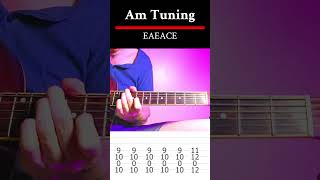
The 'Melancholy A9 Tuning' (E-A-C-E-G-B) offers a truly unique and evocative soundscape, perfectly capturing the essence of being "a bit sad and weirdly folky" as described. This innovative tuning is meticulously designed to resonate as an open A minor 9 (Am9) chord, making it an ideal choice for guitarists seeking to infuse their music with sophisticated harmony and a deeply melancholic or introspective mood. When strummed or fingerpicked open, the strings immediately yield a rich, full Am9 chord, opening doors to distinct melodic and harmonic explorations.
Technical Analysis:
The open notes of this tuning are E2 (6th string), A2 (5th string), C3 (4th string), E3 (3rd string), G3 (2nd string), and B3 (1st string). When these notes are organized around the root note A, they clearly form an A minor 9 chord (A-C-E-G-B). The voicing is particularly resonant due to the presence of the root (A) on the 5th string, with the lowest note being E, the perfect fifth of Am. The repetition of the E note (on the 6th and 3rd strings) enhances the tuning's sustain and harmonic density. This setup encourages a fresh perspective on chord shapes and scale patterns, diverging significantly from standard tuning conventions.
Open Chords & Accessible Shapes:
- Open A minor 9 (Am9): The most prominent feature of this tuning is the open A minor 9 chord (E-A-C-E-G-B), which rings out beautifully without any fretting. This provides an immediate foundation for composition and improvisation.
- Open E minor (Em): By utilizing strings 6, 3, 2, and 1 (E-E-G-B), you can achieve a resonant E minor chord, optionally with an added B (9th from E) for an Em(add9) feel.
- Open C Major 7 (CMaj7): Focusing on strings 4, 3, 2, and 1 (C-E-G-B) while muting the lower strings, effortlessly produces a bright and full C major 7 chord.
- Barre Chords: A significant advantage of open chord tunings is the ease with which other chords can be formed by simply barring across all strings. For instance, barring all strings at the 1st fret will produce an F minor 9 (Fm9), at the 2nd fret an F#m9, and so on, allowing for a wide range of minor 9th chords across the fretboard.
- G Major (G): Fretting the 4th string at the 2nd fret (to change C to D), along with the open 2nd (G) and 1st (B) strings, allows for a G-B-D triad on the upper strings.
How to Tune:
To achieve the 'Melancholy A9 Tuning', you will be performing significant down-tunings on most strings from standard EADGBe. It is crucial to proceed slowly and carefully, using a reliable tuner. Pay particular attention to the substantial drops in pitch.
- 6th String (Low E): Keep as is; no change (0 semitones). Your E2 remains E2.
- 5th String (A): Keep as is; no change (0 semitones). Your A2 remains A2.
- 4th String (D): Tune down 2 semitones to C. Change your D3 to C3.
- 3rd String (G): Tune down 3 semitones to E. Change your G3 to E3.
- 2nd String (B): Tune down 4 semitones to G. Change your B3 to G3. (Note: Tuning down 4 semitones introduces a notable decrease in string tension. For sustained use or optimal playability and intonation, considering a slightly heavier gauge string is advised.)
- 1st String (High E): Tune down 5 semitones to B. Change your E4 to B3. (Note: This is a very significant drop of 5 semitones. To maintain proper tension, intonation, and string longevity, it is highly recommended to use a heavier gauge string for the 1st string when adopting this deep down-tuning.)
String 6: E2 (Lowest Pitch)
String 5: A2
String 4: C3
String 3: E3
String 2: G3
String 1: B3 (Highest Pitch)
Loading an obscene
amount of Chords
Loading an obscene
amount of Scales
Loading Tuning Map
Loading Tuning Data
Comments - have your say on EACEGB
Capos for EACEGB
| Capo | Tuning | Name |
|---|---|---|
| 0 | EACEGB | Melancholy A9 Tuning |
Please use the below form to submit a song for EACEGB that is not already on gtdb.org.
Videos for EACEGB on















Tuning Map
- Fret
- S6
- S5
- S4
- S3
- S2
- S1
- -13
- D#
- G#
- C#
- F#
- A#
- D#
- -12
- E
- A
- D
- G
- B
- E
- -11
- F
- A#
- D#
- G#
- C
- F
- -10
- F#
- B
- E
- A
- C#
- F#
- -9
- G
- C
- F
- A#
- D
- G
- -8
- G#
- C#
- F#
- B
- D#
- G#
- -7
- A
- D
- G
- C
- E
- A
- -6
- A#
- D#
- G#
- C#
- F
- A#
- -5
- B
- E
- A
- D
- F#
- B
- -4
- C
- F
- A#
- D#
- G
- C
- -3
- C#
- F#
- B
- E
- G#
- C#
- -2
- D
- G
- C
- F
- A
- D
- -1
- D#
- G#
- C#
- F#
- A#
- D#
- 0
- E
- A
- D
- G
- B
- E
- 1
- F
- A#
- D#
- G#
- C
- F
- 2
- F#
- B
- E
- A
- C#
- F#
- 3
- G
- C
- F
- A#
- D
- G
- 4
- G#
- C#
- F#
- B
- D#
- G#
- 5
- A
- D
- G
- C
- E
- A
- 6
- A#
- D#
- G#
- C#
- F
- A#
- 7
- B
- E
- A
- D
- F#
- B
- 0
- 0
- -2
- -3
- -4
- -5
 © 2026 GTDB