EADEEA Bass Electric Tuner
EADEEA Balalaika (Bass) - Bass Electric tuning, chords & scales
Verbal Analysis
The Balalaika Bass Tuning offers a truly distinctive sonic palette for the adventurous bassist. Drawing inspiration from the traditional Russian balalaika, this 6-string electric bass setup moves beyond conventional bass voicings to open up new harmonic and melodic possibilities. It's particularly well-suited for players seeking to explore drone-based textures, rich open string harmonies, and unique chordal accompaniment that can fill more space in a mix. The presence of unison and octave notes provides a solid foundation for rhythmic driving lines, while the non-standard intervals on the higher strings encourage creative fingerings and lead lines that defy typical bass patterns.
Technical Analysis
This tuning configures your 6-string electric bass to the following open notes: E2-A2-D3-E3-E3-A4. The lower three strings (E2-A2-D3) maintain the familiar perfect fourth intervals of a standard bass setup, providing a solid foundation for traditional basslines and power chords. However, the tuning takes a unique turn with the upper strings:
- D3 to E3: A major second interval, which is less common in standard tunings and opens up new melodic and harmonic ideas.
- E3 to E3: A unison, creating a powerful drone and reinforcement of the E note, allowing for thick textures and sustained notes.
- E3 to A4: A perfect fourth, but an octave higher than the A2 string, providing bright, shimmering top-end possibilities.
Open String Harmonies & Chords
When played open, this tuning features the notes E, A, and D. This unique combination immediately suggests an E7sus4 without the B (E-A-D) or a Dsus2 over an E bass (D-E-A with E as the root). The repeating E notes (E2, E3, E3) and A notes (A2, A4) are excellent for:
- Drone Work: Easily sustain the low E or A while playing melodies on other strings.
- Power Chords: Simple two or three-finger shapes across the lower E-A-D strings will yield powerful root-fifth or root-fourth voicings.
- Suspended Chords: The D-E-E-A arrangement on the upper strings naturally lends itself to Dsus2-like harmonies (D-E-A), providing a bright, open sound that can be easily shifted to create other suspended voicings.
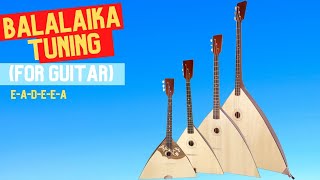
- Balalaika-esque Voicings: The E-E-A grouping on the higher strings directly echoes the traditional balalaika's E-E-A tuning, making it easy to adapt traditional balalaika strums and chord shapes to the bass, particularly for an A major or A minor tonality.
This tuning encourages a different approach to the fretboard, favoring intervals and shapes that might not be intuitive in standard tuning, making it a fertile ground for experimental and genre-bending music.
How to Tune Your Bass
Achieving the Balalaika Bass Tuning involves some significant string adjustments from a standard 6-string guitar-like E-A-D-G-B-E reference. Please take care during tuning. For optimal performance and string health, consider the following:
- For strings tuned down by more than 4 semitones, a heavier gauge string may be advised to maintain tension and avoid floppiness.
- For strings tuned up by more than 4 semitones, a lighter gauge string may be advised to prevent excessive tension and potential string breakage.
Here's a detailed guide for each string:
- String 6 (E2): Keep as is; no change from its standard E2 note (0 semitones).
- String 5 (A2): Keep as is; no change from its standard A2 note (0 semitones).
- String 4 (D3): Keep as is; no change from its standard D3 note (0 semitones).
- String 3 (E3): Tune down 3 semitones from its standard G3 note.
- String 2 (E3): Tune down 7 semitones from its standard B3 note. Caution: This is a significant drop. Consider using a heavier gauge string for this position to maintain playability and tone.
- String 1 (A4): Tune up 5 semitones from its standard E4 note. Caution: This is a substantial increase in tension. Consider using a lighter gauge string for this position to prevent undue stress on the string and instrument.
Loading an obscene
amount of Chords
Loading an obscene
amount of Scales
Loading Tuning Map
Loading Tuning Data
Comments - have your say on EADEEA
Capos for EADEEA
| Capo | Tuning | Name |
|---|---|---|
| 0 | EADEEA | Balalaika (Bass) |
Please use the below form to submit a song for EADEEA that is not already on gtdb.org.
Videos for EADEEA on






Tuning Map
- Fret
- S6
- S5
- S4
- S3
- S2
- S1
- -13
- D#
- G#
- C#
- F#
- A#
- D#
- -12
- E
- A
- D
- G
- B
- E
- -11
- F
- A#
- D#
- G#
- C
- F
- -10
- F#
- B
- E
- A
- C#
- F#
- -9
- G
- C
- F
- A#
- D
- G
- -8
- G#
- C#
- F#
- B
- D#
- G#
- -7
- A
- D
- G
- C
- E
- A
- -6
- A#
- D#
- G#
- C#
- F
- A#
- -5
- B
- E
- A
- D
- F#
- B
- -4
- C
- F
- A#
- D#
- G
- C
- -3
- C#
- F#
- B
- E
- G#
- C#
- -2
- D
- G
- C
- F
- A
- D
- -1
- D#
- G#
- C#
- F#
- A#
- D#
- 0
- E
- A
- D
- G
- B
- E
- 1
- F
- A#
- D#
- G#
- C
- F
- 2
- F#
- B
- E
- A
- C#
- F#
- 3
- G
- C
- F
- A#
- D
- G
- 4
- G#
- C#
- F#
- B
- D#
- G#
- 5
- A
- D
- G
- C
- E
- A
- 6
- A#
- D#
- G#
- C#
- F
- A#
- 7
- B
- E
- A
- D
- F#
- B
- 0
- 0
- 0
- -3
- -7
- 5
 © 2026 GTDB