GAEGBE Guitar Tuner
GAEGBE Standard G Variant - Guitar tuning, chords & scales
Verbal Analysis: Ascendant G-E Tuning
The Ascendant G-E Tuning, a dynamic variant that significantly departs from standard EADGBe, reshapes the lower register of your guitar. By raising the low E string to G and the D string to E, this tuning introduces a brighter, more open, and resonant character, particularly in the bass. It offers a fresh sonic palette, emphasizing G and E notes throughout the instrument and inviting players to explore new harmonic possibilities, moving away from conventional voicings.
Technical Analysis: Ascendant G-E Tuning
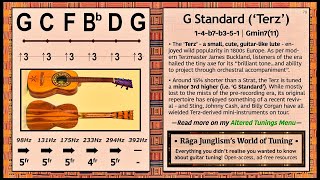
This tuning sets the open strings to G2, A2, E3, G3, B3, E4 from lowest to highest. Compared to standard E tuning, the low E string is raised a major third, and the D string is raised a whole step. The resulting open string notes are:
- String 6: G2
- String 5: A2
- String 4: E3
- String 3: G3
- String 2: B3
- String 1: E4
The notes present across the open strings are G, A, B, and E, offering a rich harmonic foundation that leans towards G major and E minor tonalities.
Open Chords and Reachable Shapes:
- E minor (Em): The open strings E3, G3, and B3 (strings 4, 3, and 2 respectively) naturally form an E minor triad. This makes open Em chords exceptionally resonant and easily accessible, providing a strong anchor for minor key compositions.
- G Major (Implied/Extended): While a complete G Major triad (G-B-D) is not directly available on open strings (the D is missing), the strong presence of G (string 6 & 3) and B (string 2), combined with E (a 6th from G), creates a sound reminiscent of a Gmaj6 or Gmaj6/9. Fretting the high E string (string 1) at the 3rd fret to D would complete a powerful open G Major chord, making it readily available.
- A minor (Am) / C Major (C): The A and E notes are present, hinting at A minor or C major. Adding the missing C note (e.g., by fretting the B string at the 1st fret to C) would easily complete an A minor or C major chord, opening up common diatonic possibilities.
This tuning's unique structure encourages fresh fingerings for common chords and fosters the exploration of drone-based harmonies, particularly around G and E. The re-pitched lower strings will necessitate re-thinking traditional barre chord shapes, opening doors to innovative voicings and chord inversions.
How to Tune: Ascendant G-E Tuning
To achieve the Ascendant G-E Tuning from standard EADGBe, follow these steps:
- String 6 (Low E to G2): Tune up 3 semitones. Your lowest E2 string should be raised to G2. Please exercise care when tuning this string up significantly to avoid string breakage due to increased tension.
- String 5 (A to A2): Keep as is; no change (0 semitones). This string remains at its standard A2 pitch.
- String 4 (D to E3): Tune up 2 semitones. Your D3 string should be raised to E3. Please exercise care when tuning this string up significantly to avoid string breakage due to increased tension.
- String 3 (G to G3): Keep as is; no change (0 semitones). This string remains at its standard G3 pitch.
- String 2 (B to B3): Keep as is; no change (0 semitones). This string remains at its standard B3 pitch.
- String 1 (High E to E4): Keep as is; no change (0 semitones). This string remains at its standard E4 pitch.
String 6 (Lowest String): Tuned to G2. This string is raised three semitones from its standard E2 pitch, creating a deeper and more resonant bass foundation.
String 5: Tuned to A2. This string maintains its standard pitch, providing a familiar anchor for chord shapes.
String 4: Tuned to E3. This string is raised two semitones from its standard D3 pitch, contributing to the bright, open character of the tuning.
String 3: Tuned to G3. This string maintains its standard pitch, acting as a core harmonic component.
String 2: Tuned to B3. This string maintains its standard pitch, essential for forming major and minor triads.
String 1 (Highest String): Tuned to E4. This string maintains its standard pitch, offering a familiar high voice for melodies and chords.
Loading an obscene
amount of Chords
Loading an obscene
amount of Scales
Loading Tuning Map
Loading Tuning Data
Comments - have your say on GAEGBE
Capos for GAEGBE
| Capo | Tuning | Name |
|---|---|---|
| -2 | FGDFAD | Open G 7sus2 |
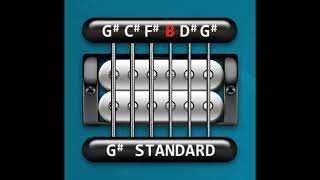
| -1 | F#G#D#F#A#D# | F#Sus2/F#maj |
| 0 | GAEGBE | Standard G Variant |
Please use the below form to submit a song for GAEGBE that is not already on gtdb.org.
Videos for GAEGBE on










Tuning Map
- Fret
- S6
- S5
- S4
- S3
- S2
- S1
- -13
- D#
- G#
- C#
- F#
- A#
- D#
- -12
- E
- A
- D
- G
- B
- E
- -11
- F
- A#
- D#
- G#
- C
- F
- -10
- F#
- B
- E
- A
- C#
- F#
- -9
- G
- C
- F
- A#
- D
- G
- -8
- G#
- C#
- F#
- B
- D#
- G#
- -7
- A
- D
- G
- C
- E
- A
- -6
- A#
- D#
- G#
- C#
- F
- A#
- -5
- B
- E
- A
- D
- F#
- B
- -4
- C
- F
- A#
- D#
- G
- C
- -3
- C#
- F#
- B
- E
- G#
- C#
- -2
- D
- G
- C
- F
- A
- D
- -1
- D#
- G#
- C#
- F#
- A#
- D#
- 0
- E
- A
- D
- G
- B
- E
- 1
- F
- A#
- D#
- G#
- C
- F
- 2
- F#
- B
- E
- A
- C#
- F#
- 3
- G
- C
- F
- A#
- D
- G
- 4
- G#
- C#
- F#
- B
- D#
- G#
- 5
- A
- D
- G
- C
- E
- A
- 6
- A#
- D#
- G#
- C#
- F
- A#
- 7
- B
- E
- A
- D
- F#
- B
- 3
- 0
- 2
- 0
- 0
- 0
 © 2026 GTDB