GDGCFA#DG Guitar Tuner
GDGCFA#DG | GDGCFB♭DG 8-string Drop G - Guitar tuning, chords & scales
Tuning Analysis: 8-string Drop G
The '8-string Drop G' tuning is designed for an 8-string guitar, offering a deep and powerful sonic foundation, yet it presents some highly unconventional characteristics that demand careful consideration. It aims to establish a variant of a 'Drop G' feel, commonly associated with heavy genres.
Verbal Description
This tuning centers around a formidable low G power chord formed by the three thickest strings (G1-D2-G2), providing immense low-end punch suitable for heavy riffs and chugging. The subsequent strings follow a pattern of perfect fourths (G2-C3-F3), a common interval structure in modern extended-range tunings that facilitates easy power chord shapes across these strings with minimal fret-hand movement.
However, the tuning takes a very unusual turn with the 3rd string tuned to A#4 (Bb4). This is an exceptionally high pitch for this string position, creating a massive leap in frequency from the 4th string (F3). Furthermore, the 2nd string is then tuned to D4, which is *lower* in pitch than the 3rd string's A#4. This creates a rare 're-entrant' or 'crossover' tuning effect between the 3rd and 2nd strings, where the string order no longer strictly ascends in pitch.
Technical Analysis
- Open G Power Chord: Strings 8 (G1), 7 (D2), and 6 (G2) form a robust open G power chord (Root, Perfect 5th, Octave), ideal for foundational riffs.
- Perfect Fourths: Strings 6 (G2), 5 (C3), and 4 (F3) are tuned in perfect fourths, a common and ergonomic interval for power chord shapes in modern metal and progressive music.
- High Tension on String 3: The 3rd string is tuned to A#4 (Bb4). This note is significantly higher than typically found on a guitar's 3rd string, requiring extremely high tension or a much lighter string gauge. From F3 to A#4 is an interval of 16 semitones, not a standard step for adjacent strings.
- Re-entrant Pitch: The most unique aspect is the pitch progression from String 3 (A#4) to String 2 (D4). A#4 is approximately 466 Hz, while D4 is approximately 293 Hz. This means String 2 is tuned *lower* in pitch than String 3. This 're-entrant' configuration is highly unconventional for a guitar, making traditional scale and chord patterns difficult and implying a specialized playing style or instrument setup.
- Upper Strings: Strings 2 (D4) and 1 (G4) complete a perfect fourth interval, establishing another G power chord fragment (D-G) on the higher strings.
Chords and Playability
The open tuning prominently features a G power chord (G-D-G) on the lowest three strings, which can be easily played with one finger across a single fret for root-fifth-octave harmony. The perfect fourths on strings 6, 5, and 4 also facilitate standard power chord shapes. However, the extreme pitch of A#4 on string 3 and the subsequent drop to D4 on string 2 makes forming conventional open chords or arpeggios exceptionally challenging. This tuning is likely intended for very specific melodic or harmonic textures, or for highly specialized riffing that leverages these unique intervals rather than traditional chord voicings.
How to Tune
To achieve the '8-string Drop G' tuning, starting from a standard 8-string (F#1 B1 E2 A2 D3 G3 B3 E4) tuning, adjust your strings as follows:
- String 8 (G1): Tune up 1 semitone to G1.
- String 7 (D2): Tune up 3 semitones to D2.
- String 6 (G2): Tune up 3 semitones to G2.
- String 5 (C3): Tune up 3 semitones to C3.
- String 4 (F3): Tune up 3 semitones to F3.
- String 3 (A#4): Tune up 3 semitones to A#4 (Bb4). Note: Achieving this pitch for the 3rd string (A#4) represents a very significant increase in tension. Consider using a much lighter gauge string for this position, as standard gauges may be under extreme stress and prone to breakage.
- String 2 (D4): Tune up 3 semitones to D4.
- String 1 (G4): Tune up 3 semitones to G4.
Important Note on String Gauge: Several strings require tuning up 3 semitones. While this is just under the general recommendation to consider a different gauge for movements exceeding 4 semitones, these are still significant increases in tension. Pay close attention to your guitar's neck relief and string tension, especially for the 3rd string (A#4) which is an exceptionally high pitch for this string position. A lighter gauge string may be necessary for optimal playability and to prevent string breakage or neck damage.
Here are the notes for each string in the '8-string Drop G' tuning, from the lowest (8th string) to the highest (1st string):
- String 8: G1 (The lowest G note, serving as the root of the tuning's powerful low end.)
- String 7: D2 (A perfect fifth above the 8th string, creating a resonant G power chord with the two lowest strings.)
- String 6: G2 (An octave above the 8th string and a perfect fourth above the 7th string, completing a strong G power chord.)
- String 5: C3 (A perfect fourth above the 6th string, continuing a series of common intervals.)
- String 4: F3 (A perfect fourth above the 5th string, maintaining the consistent interval pattern.)
- String 3: A#4 (Bb4) (An unusually high pitch for this string, creating a massive leap from the 4th string. This note is equivalent to the 4th fret on a standard E string guitar.)
- String 2: D4 (Critically, this note is lower in pitch than the 3rd string, resulting in a rare re-entrant tuning configuration for an electric guitar.)
- String 1: G4 (A perfect fourth above the 2nd string, rounding out the higher register with a G note.)
Loading an obscene
amount of Chords
Loading an obscene
amount of Scales
Loading Tuning Map
Loading Tuning Data
Comments - have your say on GDGCFA#DG
Capos for GDGCFA#DG
| Capo | Tuning | Name |
|---|---|---|
| -10 | AEADGCEA | 8 Strings Drop A |
| -9 | A#FA#D#G#C#FA# | Double Drop A# (8 String Tuning) |
| -8 | BF#BEADF#B | B1F2B2E3A3D4F4B4 |
| -7 | CGCFA#D#GC | Double Drop C (8-String Guitar) |
| -6 | C#G#C#F#BEG#C# | Drop C# |
| -5 | DADGCFAD | Ultra-Low Drop D (8-String) |
| -4 | D#A#D#G#C#F#A#D# | Double Dropped F Standard 8-string |
| -3 | EBEADGBE | 8 String Drop E |
| -2 | FCFA#D#G#CF | Drop F 8-string |
| -1 | F#C#F#BEAC#F# | Drop F# - 8 String |
| 0 | GDGCFA#DG | 8-string Drop G |
Please use the below form to submit a song for GDGCFA#DG that is not already on gtdb.org.
Videos for GDGCFA#DG on

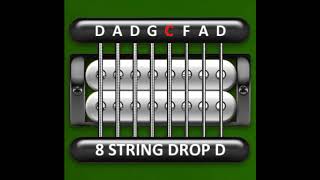











Tuning Map
- Fret
- S8
- S7
- S6
- S5
- S4
- S3
- S2
- S1
- -13
- F
- A#
- D#
- G#
- C#
- F#
- A#
- D#
- -12
- F#
- B
- E
- A
- D
- G
- B
- E
- -11
- G
- C
- F
- A#
- D#
- G#
- C
- F
- -10
- G#
- C#
- F#
- B
- E
- A
- C#
- F#
- -9
- A
- D
- G
- C
- F
- A#
- D
- G
- -8
- A#
- D#
- G#
- C#
- F#
- B
- D#
- G#
- -7
- B
- E
- A
- D
- G
- C
- E
- A
- -6
- C
- F
- A#
- D#
- G#
- C#
- F
- A#
- -5
- C#
- F#
- B
- E
- A
- D
- F#
- B
- -4
- D
- G
- C
- F
- A#
- D#
- G
- C
- -3
- D#
- G#
- C#
- F#
- B
- E
- G#
- C#
- -2
- E
- A
- D
- G
- C
- F
- A
- D
- -1
- F
- A#
- D#
- G#
- C#
- F#
- A#
- D#
- 0
- F#
- B
- E
- A
- D
- G
- B
- E
- 1
- G
- C
- F
- A#
- D#
- G#
- C
- F
- 2
- G#
- C#
- F#
- B
- E
- A
- C#
- F#
- 3
- A
- D
- G
- C
- F
- A#
- D
- G
- 4
- A#
- D#
- G#
- C#
- F#
- B
- D#
- G#
- 5
- B
- E
- A
- D
- G
- C
- E
- A
- 6
- C
- F
- A#
- D#
- G#
- C#
- F
- A#
- 7
- C#
- F#
- B
- E
- A
- D
- F#
- B
- 1
- 3
- 3
- 3
- 3
- 3
- 3
- 3
 © 2026 GTDB