GGDGBG Guitar Tuner
GGDGBG Open G Overtones - Guitar tuning, chords & scales
Description - Open G Overtones
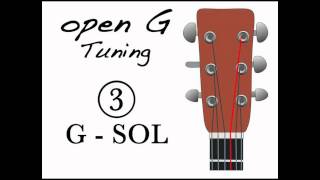
Open G tuning with overtones of G. Different than the regular open G tuning, the sixth string is tuned to G1 creating the other open strings its second(octave), third, fourth, fifth and sixth overtones creating a nice ringing harmony. The sixth string has also considerably low tone, within bass guitar range. Joni Mitchell and Mick Ralphs are known to use this tuning.
Verbal Description: Open G Overtones
This is an intriguing variant of Open G tuning, aptly named "Open G Overtones." As the original description highlights, it's distinct from standard Open G, primarily due to the foundational sixth string being tuned to a remarkably low G1. This low G then sets up the subsequent open strings to resonate as its second (octave), third, fourth, fifth, and sixth overtones, creating a rich, ringing harmony that is both full and resonant. The sonic characteristic is particularly deep, with the sixth string delving into a range typically associated with bass guitars, providing a powerful, almost orchestral foundation. This unique and sonically rich tuning has found favour with legendary musicians such as Joni Mitchell and Mick Ralphs, known for their innovative approaches to guitar.
Technical Analysis: Open G Overtones (G1-G2-D3-G3-B3-G4)
The Open G Overtones tuning configures the guitar's open strings to G1-G2-D3-G3-B3-G4, forming a robust G Major chord (G-B-D) spread across multiple octaves. Analyzing the intervals relative to the fundamental G1:
- String 6 (G1): The root, providing a deep, resonant foundation.
- String 5 (G2): An octave above the root (P8).
- String 4 (D3): A perfect fifth above the root (P5), completing the G Major triad.
- String 3 (G3): Two octaves above the root (P15 or P8 from G2), reinforcing the G.
- String 2 (B3): A major third above the root (M3), providing the major tonality.
- String 1 (G4): Three octaves above the root (P22 or P8 from G3), adding brightness and sustain.
How to Tune: Open G Overtones
To achieve the Open G Overtones tuning, follow these precise string adjustments:
- String 6 (Low E): Tune down 9 semitones from E2 to G1. Caution: This is a significant drop. For optimal tone and string tension, consider using a heavier gauge string for this position.
- String 5 (A): Tune down 2 semitones from A2 to G2.
- String 4 (D): Keep as is; no change (0 semitones). It remains D3.
- String 3 (G): Keep as is; no change (0 semitones). It remains G3.
- String 2 (B): Keep as is; no change (0 semitones). It remains B3.
- String 1 (High E): Tune up 3 semitones from E4 to G4. Take care when tuning up, especially if your guitar is not accustomed to higher tension. Listen for any stress on the neck.
String 5: G2
String 4: D3
String 3: G3
String 2: B3
String 1: G4
Loading an obscene
amount of Chords
Loading an obscene
amount of Scales
Loading Tuning Map
Loading Tuning Data
Comments - have your say on GGDGBG
Capos for GGDGBG
| Capo | Tuning | Name |
|---|---|---|
| 0 | GGDGBG | Open G Overtones |
Please use the below form to submit a song for GGDGBG that is not already on gtdb.org.
Videos for GGDGBG on
















Tuning Map
- Fret
- S6
- S5
- S4
- S3
- S2
- S1
- -13
- D#
- G#
- C#
- F#
- A#
- D#
- -12
- E
- A
- D
- G
- B
- E
- -11
- F
- A#
- D#
- G#
- C
- F
- -10
- F#
- B
- E
- A
- C#
- F#
- -9
- G
- C
- F
- A#
- D
- G
- -8
- G#
- C#
- F#
- B
- D#
- G#
- -7
- A
- D
- G
- C
- E
- A
- -6
- A#
- D#
- G#
- C#
- F
- A#
- -5
- B
- E
- A
- D
- F#
- B
- -4
- C
- F
- A#
- D#
- G
- C
- -3
- C#
- F#
- B
- E
- G#
- C#
- -2
- D
- G
- C
- F
- A
- D
- -1
- D#
- G#
- C#
- F#
- A#
- D#
- 0
- E
- A
- D
- G
- B
- E
- 1
- F
- A#
- D#
- G#
- C
- F
- 2
- F#
- B
- E
- A
- C#
- F#
- 3
- G
- C
- F
- A#
- D
- G
- 4
- G#
- C#
- F#
- B
- D#
- G#
- 5
- A
- D
- G
- C
- E
- A
- 6
- A#
- D#
- G#
- C#
- F
- A#
- 7
- B
- E
- A
- D
- F#
- B
- -9
- -2
- 0
- 0
- 0
- 3
 © 2026 GTDB